 홈으로
> 스포츠
> 축구
> EURO 2000 > 역대 우승국
> 1992년
홈으로
> 스포츠
> 축구
> EURO 2000 > 역대 우승국
> 1992년 |
|
홈으로
> 스포츠
> 축구
> EURO 2000 > 역대 우승국
> 1992년 |
| European Championship - Sweden
1992
Whereas attendances at the 1980 finals had been disappointing for any matches that didn´t feature the hosts, those in Euro 92 were limited by stadium size not enthusiasm, which was provided in spades by fans of traditionally well-supported countries with little of the hooligan violence that had accompanied some of these teams in the past. It was probably the most vibrant and cosmopolitan finals tournament yet. On the footballing front, France arrived with a perfect record in qualifying, winning all eight matches, including four against countries as strong as Spain and Czechoslovakia. Twelve of their twenty goals were scored by their main strikers Jean-Pierre Papin and Eric Cantona. The only cloud on the horizon was a 2-0 defeat at Wembley, in which a 21-year-old called Alan Shearer had scored on his debut. Before that, England had qualified without impressing. New manager Graham Taylor opted to select a squad without the proven talents of Chris Waddle and Bryan Robson and apparently harbouring concerns about Gary Lineker´s work-rate - though he and the rest of the country were grateful for the latter´s late equaliser in Poland which sent England through at the expense of the Republic of Ireland. Add to that the injuries just before the finals, and England travelled more in hope than expectation.
The same applied to Scotland, who qualified for the first time after emerging from a very tight group in which only two points separated them, Switzerland, Romania and Bulgaria. Short on individual stars, but high on teamwork, the Scots were grateful for Gheorghe Hagi´s penalty miss in Bulgaria. In the finals, the Scots suffered their usual fate of being unlucky in their choice of opponents, being drawn in the same group as Germany and defending champions the Netherlands, who retained several of their stars from 1988. England would play France and the hosts, who had the new attacking talents of Tomas Brolin, Martin Dahlin and Kennet Andersson but a manager who worried about their inexperienced defence. Elsewhere the political map was changing. The Soviet Union, temporarily known as the CIS (Commonwealth of Independent States) before it began abolishing itself, qualified ahead of Italy without losing a match. Above all, the horrors in Bosnia, and the subsequent United Nations sanctions, kept Yugoslavia´s team out of the finals at a time when even for a country with a reputation as a conveyor belt for skilful players, they had some of the most outrageously talented players they had ever produced: Dejan Savicevic, Dragan Stojkovic, Zvonimir Boban, Robert Prosinecki, Davor Suker, Robert Jarni, Sinisa Mihajlovic, Predrag Mijatovic. Some had helped FK Crvena Zvezda win the 1991 European Champion Clubs' Cup, others went on to do exciting things for Croatia. Nine of the 24 goals in their qualifying matches were scored by Darko Pancev, Europe´s latest goal machine. The possibilities had seemed endless. The runners-up in Yugoslavia´s group were invited to take their place
in the finals, but after three defeats in EURO '88 and with Michael Laudrup
refusing to play for the new manager, no-one expected too much of Denmark.
|
| 9회 대회 - 기적의 덴마크
'기적의 덴마크' 1992년 스웨덴에서 벌어진 9회 대회에서는 '바이킹의 후예' 덴마크가 기적의 우승을 일궈냈다. 덴마크는 지역예선에서 유고슬라비아에 밀리며 본선행이 좌절됐다. 하지만 유고슬라비아가 내전으로 대회불참을 선언하면서 행운의 본선티켓을 거머쥐게 됐다. 그리고 덴마크는 본선에서 누구도 예상치 못했던 기적을 만들어냈다. 8강 조별예선에서 덴마크는 홈팀 스웨덴, 축구종가 잉글랜드, 우승후보 프랑스와 같은 조에 속했다. 많은 축구전문가들이 '탈락 1순위'로 덴마크를 꼽았다. 그러나 덴마크는 프랑스를 꺾는 등 선전을 거듭하며 1승1무1패로 죽음의 조를 통과했다. 준결승에 오른 덴마크는 디펜딩챔피언 네덜란드를 만났다. 덴마크는 열세의 예상을 뒤엎고 치열한 접전을 펼치며 2-2로 정규시간을 마쳤다. 그리고 승부차기에서 5-4로 승리하며 결승에 진출했다. 결승상대는 1990년 이탈리아월드컵 우승에 빛나는 자타공인의 최강팀, 전차군단 독일. 대부분의 사람들이 독일의 낙승을 예상했다. 그러나 '기적의 팀'에게 불가능이란 없었다. 덴마크는 옌센과 빌모츠의 연속골을 앞세워 '최강의 전차군단'을 2-0으로 제압했다. 어부지리로 본선티켓을 얻은 바이킹의 후예들이 기적을 창조하는 순간이었다. 한편 이 대회부터 서독과 동독은 통일이후 처음으로 한 나라인 독일로서
대회에 참가하게 되었다. 또한 소련분리와 함께 독립국가연합(CIS)이 대회에
참가했다.
스포츠서울닷컴 |
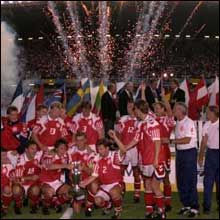 Denmark
celebrate winning EURO '92 in Sweden
Denmark
celebrate winning EURO '92 in Sweden