 홈으로
> 스포츠
> 축구
> EURO 2000 > 역대 우승국
> 1996년
홈으로
> 스포츠
> 축구
> EURO 2000 > 역대 우승국
> 1996년 |
|
홈으로
> 스포츠
> 축구
> EURO 2000 > 역대 우승국
> 1996년 |
| European Football Championship
- England 1996
Where better to stage the biggest European Football Championship Final Tournament, but in the country that gave the game to the Continent. Sixteen teams, double the previous number, were divided into four groups of four, the top two going into the quarter-finals, which were introduced for the first time. There were other innovations. The position of teams level on points would be decided not by goal difference but the result of the match between the two. And the knockout stages would see the introduction of the ´golden goal´ for the first time in any senior international competition: the first goal in extra time would decide the match.
As in the FIFA World Cup, England were hoping to overturn a dismal record in the event by winning it at home. Whether they had the team and tactics to do it, nobody was completely sure. Not even their new manager, or so it seemed. When Graham Taylor was ousted after failing to qualify for the intervening World Cup, the English Football Association picked Terry Venables, who built up an unbeaten record against European opposition. Some bright young talent was brought in (Darren Anderton, Steve McManaman, Jamie Redknapp, and the Neville brothers, Phil and Gary) but the team was still dependent on Paul Gascoigne for its midfield impetus, and the goals had dried up for Alan Shearer. It looked as if home advantage would have to be decisive if England were to win something for the first time in 30 years. At least the year ended in a six again. And the opposition did not look overpowering. In fact England had recently beaten or drawn with some of it: Bulgaria, Portugal, the talented Croatians, as well as their opponents in the opening match, Switzerland. Germany were less imposing than usual, Spain and Italy rather unknown quantities, while Russia and the Czech Republic did not arrive with huge reputations. France had left Eric Cantona out of their squad even though he had just scored the winning goal in the FA Cup Final to complete the Double for Manchester United FC. One potential threat lay in England´s group. In a play-off to decide the last place in the finals, Holland had beaten the Republic of Ireland 2-0 at Anfield, playing a brand of cool short-passing football that bore comparison with anything in the Johan Cruyff or Ruud Gullit eras. An interesting feature was the number of talented young players coming through: Michael Reiziger and Winston Bogarde at the back, Edgar Davids and Clarence Seedorf in the middle, the 19-year-old Patrick Kluivert who scored both goals. As well as this latest tribute to the Dutch youth system, England would
have to contend with Scotland, who added spice by being drawn in the same
group but whose hopes were probably restricted to reaching the quarter-finals.
For the hosts, aspirations were inevitably rather higher. England, and
the ghosts of ´66, expected.
|
| 10회 대회 - 독일 세번째 정상등극
'전차군단 V3' 1996년 잉글랜드에서 벌어진 10회 대회를 기점으로 본선 참가국이 종전 8개국에서 16개국으로 증가하게 되었다. 16개팀이 4개조로 나뉘어 조별예선을 치르고, 각 조 1,2위팀이 8강에 진출해 크로스 토너먼트로 우승팀을 가리는 방식이 채택되었다. 이렇게 참가국이 늘어난 첫 대회에서 가장 빛났던 스타는 독일의 비밀병기 올리버 비어호프였다. 비어호프는 체코와의 결승전에서 골든골을 기록하는 등 탁월한 골감각을 발휘하며 독일의 통산 3번째 우승의 일등공신이 됐다. 독일은 이 대회 우승으로 1994미국월드컵에서 불가리아에 패하며 8강탈락했던
악몽의 충격에서 벗어날 수 있었다.
|
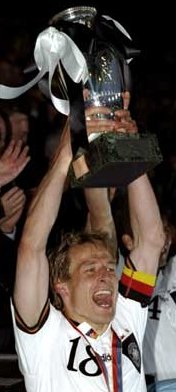 Germany's
J?rgen Klinsmann celebrates winning EURO 96™
Germany's
J?rgen Klinsmann celebrates winning EURO 96™