 홈으로 >
축구 > 1930년
우루과이 월드컵 ScoreBoard
홈으로 >
축구 > 1930년
우루과이 월드컵 ScoreBoard |
|
홈으로 >
축구 > 1930년
우루과이 월드컵 ScoreBoard |
| - 1회 우루과이 월드컵은 유럽의 경제위기, 장기간의 바다여행과 클럽들이
2달간 스타플레이어가 없이 게임을 치루는 것으로 전세계적인 호응을 받지 못했다.
- 지역별 예선전 없이 13개국이 초청을 받아 치루어 졌으며, 1개 도시 (몬테비데오) 3개의 스타디움에서 경기가 열렸다. - 루마니아에서는 선수들에게 3개월간의 휴가와 귀국후 원래 직장으로 복귀하라는
Karol왕의 칙령이 발표되었으며, 왕 자신이 루마니아의 감독직을 수행했다.
- 멕시코를 4:1로 이긴 프랑스와 아르헨티나의 게임에서는 아르헨티나가 1:0으로 근소하게 이기고 있었으며 남미 팀의 승리를 원하는 관중들로 인해 주심이 6분이나 일찍 종료휘슬을 불었다. 그러나, 거센 항의에 선수들이 다시 운동장으로 불리워졌으나 그때는 이미 일부선수들은 샤워를 하고 있었다. |
  IFA's decision
to hold the first World Cup in Uruguay did not meet universal acclaim,
as Europe was plunged in the midst of an economic crisis. Participation
in a World Cup taking place overseas involved a long sea journey. Moreover,
for some clubs it meant having to go without their best players for two
months - a problem that is still topical today. IFA's decision
to hold the first World Cup in Uruguay did not meet universal acclaim,
as Europe was plunged in the midst of an economic crisis. Participation
in a World Cup taking place overseas involved a long sea journey. Moreover,
for some clubs it meant having to go without their best players for two
months - a problem that is still topical today.
France met Mexico in the opening match and duly won 4-1 but the first final was contested by the hosts and their neighbours Argentina. After trailing 2-1 at the interval, Uruguay went on to prevail 4-2 and thus won the cup which had been designed by French sculptor Abel Lafleur. The first World Cup, the first football legends Although football was officially born in 1904 with the founding of FIFA,
it was not until 1924 and the Olympic tournament in Paris that the international
game really came into its own. There for the first time, teams from other
continents arrived to take on the Europeans. The tournament was an unmitigated
success: 50,000 spectators watched Uruguay beat Switzerland in the final.
In 1928 however, when many nations abstained from the Olympic tournament
in Amsterdam, the time was obviously ripe for a new independent football
tournament to be established especially in view of the growth of professional
football. On 26 May 1928 in Amsterdam, the FIFA congress voted that a new
tournament was to be organised in 1930 which was to be open to all member
nations. On 18 May 1929, the Barcelona congress voted that Uruguay should
be the first nation to host a World Cup.
Seafaring footballers As holders of the Olympic title and the fact that 1930 marked its 100 years of independence it was appropriate to choose Uruguay to host the first tournament. Although the news was greeted enthusiastically in all football-playing countries, many European nations harboured reservations about the prospect of crossing the Atlantic, a journey which promised to be long, tiring and costly. Thus, more and more European associations broke their promise to participate. Two months before the tournament was due to commence not a single European country had entered the competition. Thanks to Rimet's personal efforts , at least four delegations, Belgium, France, Yugoslavia and Romania, set sail on 21 June 1930 from Villefranche-Sur-Mer with the liner "Conte Verde" reaching Rio de Janeiro on 29 June, where they picked up the Brazilian squad and arrived in Montevideo on 4 July. A tremendous sporting success The first World Cup only attracted 13 nations, including four Europeans, eight from South America and a representative team from the United States. On the field of play however, the quality of football produced was of the highest standard. And whilst the public had expected to see a South American domination, the four teams from Europe did more than hold their own as typified by the French team, beating Mexico 4 - 1 and going down narrowly to Argentina 1 - 0 in an epic struggle. The referee, who had blown the final whistle six minutes early, finally - after fierce protests - recalled the players to the field, some of whom were already in the shower! First final, first legend A few days later in the colossal Centenario stadium (100,000 capacity), the atmosphere was electric as spectators were awaiting the South American final between Uruguay and Argentina. At half-time, Uruguay were down 2-1, but fought back bravely and put three second half goals passed the stunned Argentinans, ending the game with a 4-2 victory. The FIFA President Jules Rimet presented the Victoire aux Ailes d'Or trophy, a statuette 30cm high, made of gold and weighing 4 kg, to the Uruguayan captain Jose Nazassi. Celebrations in Montevideo went on for several days and nights and the day after the famous victory, the 31 July, was proclaimed a national holiday. The ball had begun to roll for football's most prestigious prize and the universal nature of the game had been officially proclaimed! Sources: FIFA Archives; CFO France 98; Ian Morrison: The World Cup - A Complete Record 1930-1990. Breedon Books, Derby (UK) 1990.; John Robinson: Soccer - The World Cup 1930-1998. Soccer Books Limited, Lincolnshire (UK) 1998 |
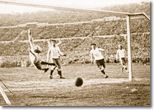 One of four goals which guaranteed
Uruguay's 4-2 victory over Argentina.
One of four goals which guaranteed
Uruguay's 4-2 victory over Argentina. For the first ever World Cup there are no qualifying rounds
- participation is by invitation only. But because of recession and the
long voyage to Uruguay by ship, lots of European teams have declined to
take part. In Romania a decree from King Carol gives the players three
months off from their jobs and a guarantee that they will be re-employed
on their return. The king himself is also active as coach. But after a
great performance from the host country, the king's men have to pack their
bags for an early trip home.
For the first ever World Cup there are no qualifying rounds
- participation is by invitation only. But because of recession and the
long voyage to Uruguay by ship, lots of European teams have declined to
take part. In Romania a decree from King Carol gives the players three
months off from their jobs and a guarantee that they will be re-employed
on their return. The king himself is also active as coach. But after a
great performance from the host country, the king's men have to pack their
bags for an early trip home.