 홈으로 >
축구 > 1950년
브라질 월드컵 ScoreBoard
홈으로 >
축구 > 1950년
브라질 월드컵 ScoreBoard |
|
홈으로 >
축구 > 1950년
브라질 월드컵 ScoreBoard |
| - 2차세계대전 내내 이탈리아인 FIFA 부회장 Ottorino Barassi 박사는 점령군이
이탈리아에 올 때까지 월드컵을 그의 침대밑 구두상자 속에 감추어 두었다.
- 지역예선에서 몇몇 팀이 제거되었고, FIFA에서 맨발로 축구를 하지 못하게 했기 때문에 인도 팀의 참가가 철회되어 모두 13개팀이 본선을 치루었다. - 46년 7월25일 룩셈부르크 회의에서 전쟁 동안 축구정신이 계속 유지되게끔 모든 것을 바친 줄리메 FIFA 회장의 축구에 대한 열정을 기리기위해 이 후로 월드컵 우승컵을 "줄리메컵"이라 부르기로 했다. - FIFA는 1929년 이후 월드컵에 참여하지 않은 영국을 참여시켰으나 영국은 미국에 1:0으로 지는 부진한 게임(1승2패)으로 예선 13강에서 탈락하였으며, 스웨덴의 아마츄어팀은 이탈리아를 3:2로 격파하면서 결승 4강리그전에 참여하게 된다. - 브라질은 멕시코를 4:0, 스위스와 2:2, 유고에 2:0으로 이기고 4강 결승리그에 도달하였으며, 결승리그에서 스웨덴을 7:1로, 스페인을 6:1로 이겨 모두가 브라질의 승리를 의심하지 않았다. 우루과이전에서 비기기만 해도 우승을 차지할 수 있었으나 2:1로 역전패 당했다. 브라질 진행 요원들은 넋을 잃고 우승컵을 주는 것도 잊어먹고 있어 줄리메가 우승컵을 주기위해 우루과이 주장을 찾으러 갔다. - 스포츠와 재정적인 면에서 대단히 성공한 경기로서 축구는 새로운 시대로 접어들었다. |
  hroughout the Second
World War the Italian Vice-President of FIFA, Dr. Ottorino Barassi, hid
the World Cup trophy in a shoe box under his bed and thus saved it from
falling into the hands of occupying troops. hroughout the Second
World War the Italian Vice-President of FIFA, Dr. Ottorino Barassi, hid
the World Cup trophy in a shoe box under his bed and thus saved it from
falling into the hands of occupying troops.
The World Cup returned and Uruguay won it for a second time in the "final which was not a final". Before that, however, the United States beat England 1-0 in Belo Horizonte and Sweden's amateurs beat Italy 3-2 in Sao Paulo. A mini-league format was used and Brazil, Sweden, Spain and Uruguay were the final contestants. Brazil needed only a draw in their clash with Uruguay to clinch the trophy, but lost 2-1 in front of a crowd of 174,000 in Rio's Maracana Stadium. Football was to live on after the Second World War
The congress also heralded the return of the British associations, absent since 1929. It was to be the Brazilian Sports Confederation, however, whose team had made such an impact on the 1938 World Cup, that was granted the responsibility of hosting the next World Cup, scheduled for 1950. Twelve years after the World Cup in France, the new competition", emerged into a new era when the tournament was staged in the famous Maracana stadium in Rio de Janeiro and other cities in Brazil. The planet's biggest stadium Football in Brazil had become so popular that it was decided to build a brand new stadium with a capacity of 220,000 in the suburbs of Rio de Janeiro. Work began on 2 August 1948. The deadline however, proved too ambitious, and building work was soon running behind schedule. Five weeks before the opening match, the Brazilian organisers found themselves somewhat overwhelmed by the situation, and FIFA decided to send Dr. Ottorino Barassi, the president of the Italian Football Federation who had so brilliantly organised the 1934 World Cup, to Rio. On 24 June 1950, the Maracana stadium was officially inaugurated, though still looking like a building site and without a press stand. But the stadium was ready to play host to the 13 teams qualified for the finals. The teams were divided into 4 groups (2 groups of 4 teams, 1 group of 3 teams and 1 group of 2 teams). A nation gets behind its team After an easy victory over Mexico (4-0), the Brazilians, to everybody's
surprise, were held to a draw (2-2) by the Swiss. Yugoslavia, having won
its first two matches, needed only a draw against the Brazilians to qualify
for the next round. But in front of a fervent 150,000-strong crowd at Maracana,
Brazil ran out winners (2-0).
Sources: FIFA Archives; CFO France 98; Ian Morrison: The World Cup - A Complete Record 1930-1990. Breedon Books, Derby (UK) 1990.; John Robinson: Soccer - The World Cup 1930-1998. Soccer Books Limited, Lincolnshire (UK) 1998 |
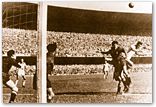
 A
total that is not likely to be equalled ever again is the 185,000 crowd
in the Maracana stadium in Rio on 16 July (unofficial sources quote the
figure as over 200,000). With the score at 1:1, Ghiggia broke the hearts
of the home supporters by scoring the winning goal eleven minutes from
time. Apart from 1958, it was the only World Cup in which the home team
reached the final and failed to win the title.
A
total that is not likely to be equalled ever again is the 185,000 crowd
in the Maracana stadium in Rio on 16 July (unofficial sources quote the
figure as over 200,000). With the score at 1:1, Ghiggia broke the hearts
of the home supporters by scoring the winning goal eleven minutes from
time. Apart from 1958, it was the only World Cup in which the home team
reached the final and failed to win the title.