 홈으로 >
축구 > 1986년
멕시코 월드컵 ScoreBoard
홈으로 >
축구 > 1986년
멕시코 월드컵 ScoreBoard |
|
홈으로 >
축구 > 1986년
멕시코 월드컵 ScoreBoard |
  he
13th World Cup was awarded to Mexico, who thus became the first country
to host the competition on two occasions. However, the Mexicans were selected
only as replacement hosts after the original choice, Colombia, announced
in 1983 that it could no longer afford to stage football's greatest tournament. he
13th World Cup was awarded to Mexico, who thus became the first country
to host the competition on two occasions. However, the Mexicans were selected
only as replacement hosts after the original choice, Colombia, announced
in 1983 that it could no longer afford to stage football's greatest tournament.
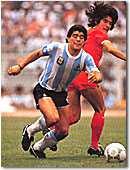
Brazil fell in the quarter-finals on penalties to France, who were in turn muscled out by the West Germans in the semi-finals. Maradona, with two goals against both England -- one a handball he proudly dubbed scored by "the hand of God", the other one of the greatest goals ever scored -- and Belgium, led Argentina through and in the final they overcame West Germany 3-2 in front of 115,000 at the Aztec Stadium. The Maradona Show A crushing blow in the form of a violent earthquake killing 20,000 people almost deprived the Mexicans of their long-awaited celebration. Eventually, however, they decided to push ahead.
Twenty-four teams took part in the finals, as had been the case four years earlier in Spain. This World Cup was different, however, in that all the second round games were played on a knock-out basis. With only eight teams not making it through, the first round threw up very few surprises. A first, however, was Morocco becoming the first African nation to qualify for the second round in a World Cup finals competition. The French, just as they had in 1982, won many fans due to their dazzling football, and the legendary and universally admired midfield foursome of Platini, Giresse, Tigana and Fernandez wrought havoc among even the best-organised defences. The World Champions go down to the "Blues" The "Blues" showed their class in ousting Italy, the world champion, in their second round game, 2-0, before overcoming Brazil in Guadalajara-rather fortuitously but with a great deal of flair-in one of the greatest match of all time. Tele Santana's Brazilians twice hit the woodwork and frequently overran Michel Platini and his French side, who eventually won the day largely due to the performance of their goalkeeper Jo? Bats-amongst other feats, he managed to save a Zico penalty 12 minutes from time. After winning a nail-biting penalty shoot-out (1-1 at full time, then 4 penalties to 3), the French reached the semis. But here, just as in Spain four years earlier, their dreams of World Cup glory were foiled by a fresher German eleven. The Germans, ever-present in the final, once again stumbled at the last step. Beaten by Italy and Paolo Rossi in 1982, this time they were pipped at the post (3-2) by the Argentinians, led by Diego Maradona, fresh from their 2-0 victory over a plucky Belgian side in the semis. Argentina's victory was as deserved as it was unexpected. The team was solid but uninspired, and it was a masterful Maradona that virtually won the World Cup for his country single-handed. His brilliance and goalscoring prowess (five goals) made him, quite naturally, the Player of the Tournament. The only cloud over the proceedings came in the quarter-finals when he scored with his hand against England. This did not, however, spoil the party in Argentina, where 30 million people celebrated in the streets after the final victory. Sources: FIFA Archives; CFO France 98; Ian Morrison: The World Cup - A Complete Record 1930-1990. Breedon Books, Derby (UK) 1990.; John Robinson: Soccer - The World Cup 1930-1998. Soccer Books Limited, Lincolnshire (UK) 1998 |
 Four
years after the very first penalty shoot-out in World Cup history - France
losing to Germany in the semifinal in Seville - fate would have it that
the same two teams would be involved in penalty decisions again. On 21
July the French had the luck this time and beat Brazil; Platini's miss
did not matter since Socrates and Julio Cesar both missed for Brazil. On
the same day Germany played out a goal-less draw against Mexico, but won
the match on penalties, thus ending the home team's dreams of winning the
title.
Four
years after the very first penalty shoot-out in World Cup history - France
losing to Germany in the semifinal in Seville - fate would have it that
the same two teams would be involved in penalty decisions again. On 21
July the French had the luck this time and beat Brazil; Platini's miss
did not matter since Socrates and Julio Cesar both missed for Brazil. On
the same day Germany played out a goal-less draw against Mexico, but won
the match on penalties, thus ending the home team's dreams of winning the
title.