 홈으로 >
축구 > 1990년 이탈리아월드컵
> 월드컵축구 FIFA총평
홈으로 >
축구 > 1990년 이탈리아월드컵
> 월드컵축구 FIFA총평 |
|
홈으로 >
축구 > 1990년 이탈리아월드컵
> 월드컵축구 FIFA총평 |
  disappointing
World Cup with too much dull defensive football and matches won on penalty
kicks. The final itself between West Germany and Argentina was the least
inspiring in the history of the competition and ironically decided by a
late penalty converted by West Germany's Andreas Brehme. Argentina became
the first team not to score in the final -- and also the first team to
have not one, but two players sent off in the final. Hosts Italy flattered
to deceive before losing on penalties in the semi-finals to Argentina.
West Germany won the other semi on penalties against England. disappointing
World Cup with too much dull defensive football and matches won on penalty
kicks. The final itself between West Germany and Argentina was the least
inspiring in the history of the competition and ironically decided by a
late penalty converted by West Germany's Andreas Brehme. Argentina became
the first team not to score in the final -- and also the first team to
have not one, but two players sent off in the final. Hosts Italy flattered
to deceive before losing on penalties in the semi-finals to Argentina.
West Germany won the other semi on penalties against England.
Germany take their place in history After Mexico in 1986, the 14th World Cup returned
to Europe: to Italy, a mighty footballing nation where no expense was to
be spared in making the World Cup a hearty success. Ten of the twelve World
Cup stadiums were given a complete facelift and the other two (in Turin
and Bari), were built from scratch especially for the event.
Even though fewer nations took part in the qualifying
rounds than in 1986 (112 rather than 121), reaching the finals proved to
be just as difficult. Among the teams that failed along the way were Denmark,
Portugal and even France, the 1986 semi-finalists having named Michel Platini
as coach to replace Henri Michel.
With the exception of the Costa Ricans, who reached the last 16 in their very first World Cup finals, the first round turned out much as expected. Three players, however - Roger Milla, Salvatore Schillaci and the Argentinian goalkeeper Sergio Goycochea - all set the crowds alight. Milla, who came out of retirement to play in the tournament, became at 38 years and 20 days the oldest goalscorer in World Cup history when he hit the net against Romania (he repeated the title in the 1994 World Cup). A few days later in the quarter-finals, the old "Lion" and his Cameroon team-mates were beaten at the death by England 3-2, after leading 2-1 with ten minutes to go. Cameroon's marvellous display, along with Egypt's excellent performance, did not go unnoticed, and meant that Africa would be able to field three - as opposed to two - teams in the next World Cup in 1994. A virtually unknown quantity at the tournament's outset, Salvatore Schillaci, better known as "Toto" in his homeland, carried an Italian eleven which, though they played entertaining football, were lacking in finishing power. Schillaci, 25, who played his club football for Juventus, was in such tremendous form-he scored six goals and finished as the tournament's top goalscorer-that he virtually lifted Italy into the semi-finals on his own. There, however, the Squadra Azzura went out on penalties against Argentina, having only let in two goals in seven games. Italy's tormentor was none other than the Argentinian goalkeeper Sergio Goycochea, who came into the side to replace the seriously injured Nery Pumpido (who had a double fracture in his shinbone). As the last man in an uninspired but ever opportunist Argentinian side, Goycochea proved to be the decisive element against Brazil in the last sixteen, and then again in the penalty shoot-out against Yugoslavia in the quarter-finals and Italy in the semis. Goycochea could do nothing, however, to stop a very disputed penalty that the Mexican referee awarded Germany in the final. The Germans, nonetheless, with victories over Yugoslavia (4-1), the Netherlands (2-1), Czechoslovakia (1-0) and England (1-1 at full time then 4 penalties to 3), were worthy champions. Well coached by Franz Beckenbauer, who had captained the 1974 German team, they counted among their ranks Matth?s, Brehme, V?ler, Klinsmann, Kohler, and H?sler, all great individual talents. In winning their third title, Germany joined Italy and Brazil as the World Cup's most honoured nations. Sources: FIFA Archives; CFO France 98; Ian Morrison: The World Cup - A Complete Record 1930-1990. Breedon Books, Derby (UK) 1990.; John Robinson: Soccer - The World Cup 1930-1998. Soccer Books Limited, Lincolnshire (UK) 1998 |
 Like
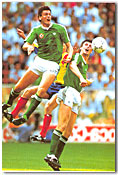
Julius Caesar before him, Salvatore "Toto" Schillaci came, saw and conquered.
For three weeks he was Italy's hero. Originally from Palermo but on the
books of Juventus, he had played exactly one international match before
the World Cup Italy 90 started. In the first Italian game he came on as
a substitute and scored the 1:0 winner against Austria four minutes later.
He was back on the bench again for the USA match, but was then used in
every game and scored in every one too. Thanks to his efforts, Italy reached
the semi-final have they went down to Argentina on penalties. In the play-off
for third place he scored again against England, and Italy at least won
the bronze medals. But his fame did not last long; top goalscorer Schillaci
was a shooting star that soon faded and he quickly lost his national team
place.
Like
Julius Caesar before him, Salvatore "Toto" Schillaci came, saw and conquered.
For three weeks he was Italy's hero. Originally from Palermo but on the
books of Juventus, he had played exactly one international match before
the World Cup Italy 90 started. In the first Italian game he came on as
a substitute and scored the 1:0 winner against Austria four minutes later.
He was back on the bench again for the USA match, but was then used in
every game and scored in every one too. Thanks to his efforts, Italy reached
the semi-final have they went down to Argentina on penalties. In the play-off
for third place he scored again against England, and Italy at least won
the bronze medals. But his fame did not last long; top goalscorer Schillaci
was a shooting star that soon faded and he quickly lost his national team
place.