 Japan 1979: All hail Maradona
Champions:
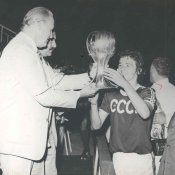 Argentina
proved unstoppable in this tournament, deploying their "toque" one-touch
football to devastating effect. In terms of footballing talent and virtuosity
going forward, the Albiceleste were in a class of their own, with Diego
Maradona, Gabriel Calderon, Ramon Diaz and Osvaldo Escudero all grabbing
their share of the headlines. Aside from the already peerless "Pibe de
Oro", Diaz demonstrated a deadly acumen in front of goal, invariably popping
up in the right place at the right time. Solid at the back, notably thanks
to Juan Simon and Hugo Alves, as well as lethal up front, Cesar Luis Menotti's
men left Poland, Yugoslavia, Uruguay and the USSR flailing in their wake
on the road to the title. In the Final against the Soviets they showed
their mettle by coming from behind to win 3-1, with inevitable goals by
the incomparable Maradona and Diaz. The tournament statistics speak for
themselves: with 20 goals for and only 2 against, Argentina were worthy
winners indeed. Argentina
proved unstoppable in this tournament, deploying their "toque" one-touch
football to devastating effect. In terms of footballing talent and virtuosity
going forward, the Albiceleste were in a class of their own, with Diego
Maradona, Gabriel Calderon, Ramon Diaz and Osvaldo Escudero all grabbing
their share of the headlines. Aside from the already peerless "Pibe de
Oro", Diaz demonstrated a deadly acumen in front of goal, invariably popping
up in the right place at the right time. Solid at the back, notably thanks
to Juan Simon and Hugo Alves, as well as lethal up front, Cesar Luis Menotti's
men left Poland, Yugoslavia, Uruguay and the USSR flailing in their wake
on the road to the title. In the Final against the Soviets they showed
their mettle by coming from behind to win 3-1, with inevitable goals by
the incomparable Maradona and Diaz. The tournament statistics speak for
themselves: with 20 goals for and only 2 against, Argentina were worthy
winners indeed.
Surprises:
The quality of football played at this second FIFA World Youth Championship
was excellent, and for once, there were no major upsets; the four semi-finalists,
Argentina, Uruguay, USSR and Poland, were all pre-tournament favourites.
Algeria did look as if they might challenge the existing hierarchy
when they reached the quarter-finals after draws with Mexico and Japan
and a win against Spain. Tough to break down and with two outstanding front
men in Derradji Bendjaballah and Rachid Kheloufi, the North Africans showed
buckets of promise - until they ran into Argentina, who gave them a footballing
lesson to remember (5-0).
Player of the Tournament:
This tournament heralded the arrival of a truly exceptional talent;
Diego Armando Maradona. Goalscorer (second best marksman in the tournament
with six goals), free-kick specialist, deft passer, Maradona had it all.
He was a fine crosser of a ball too, with a change of pace that would leave
the best defenders bewildered, and a never erring first touch of the ball,
as the footballing world would discover to its cost a few years later.
After leaving Boca Juniors and his native Argentina, he moved to Barcelona
in Spain , before a world-record transfer to Napoli in the south of Italy.
Seven years after this tournament in Japan he led his country to glory
at the 1986 FIFA World Cup Mexico¿, scoring two of the most talked-about
goals in football history.
Rising Stars:
Gabriel Calderon (ARG), Ramon Diaz (ARG), Diego Maradona (ARG), Joszef
Nagy (HUN), Antal Roth (HUN), Andrzej Buncol (POL), Jacek Kazimierski (POL),
Fernando Alvez (URU), Ruben Paz (URU), Viktor Chanov (URS), Aleksander
Zavarov (URS), …
Japan 1979 stats:
Roll of honour:
1- Argentina
2- USSR
3- Uruguay
4- Poland
Goals scored:
83 (av.: 2.59)
| Players |
Played |
Total Goals |
Penalty Goals |
| DIAZ Ramon (ARG) |
6 |
8 |
0 |
| MARADONA Diego (ARG) |
6 |
6 |
0 |
| PALASZ Andrzej (POL) |
6 |
5 |
0 |
| ROMERO Julio Cesar (PAR) |
4 |
4 |
0 |
| PAZ Ruben (URU) |
6 |
4 |
0 |
| PONOMAREV Igor (URS) |
6 |
4 |
0 |
Best attack:
Argentina, 20 goals.
Top goalscorers:
Ramon Diaz (ARG), 8 goals
Diego Maradona (ARG), 6 goals
Andrzej Palasz (POL), 5 goals
Host cities:
Kobe, Omiya, Tokyo, Yokohama
Spectators:
454,500 (Final: 52,000)
Average attendance:
14,203
Interesting stat:
Indonesia hold the unenviable record of having conceded the most goals
at a FIFA World Youth Championship. The Asian youngsters let in 16 goals.
|
 홈으로
> 스포츠
> 축구
> FIFA
세계청소년축구 > 1979년 Top
News
홈으로
> 스포츠
> 축구
> FIFA
세계청소년축구 > 1979년 Top
News