

- 오늘의 예배

- 오늘의 한글성경
- 오늘의 WEB성경
- English Bible Story
- 01.창조시대 EBS
- 02.족장시대 EBS
- 03.출애굽기 EBS
- 04.광야시대 EBS
- 05.정복시대 EBS
- 06.사사시대 EBS
- 07.통일왕국 EBS
- 08.분열왕국 EBS
- 09.포로시대 EBS
- 10.포로귀환 EBS
- 11.중간시대 EBS
- 12.예수시대 EBS
- 13.초대교회 EBS
-----Readed_count
-----Update
Mobile Bible, Mobile B-Story, Today's iWorship, 요리문답, Quiz추가&수정, Dictionary추가&수정




19. First Miracle
Three days after Jesus called Philip to follow him, there was a marriage in Cana of Galilee that was being attended by Mary, the mother of Jesus. Jesus had also been invited, and his disciples were in attendance as well.
Before the marriage festivities were over, they ran out of wine. Mary came to Jesus and told him that they had no more wine.
Jesus said to her:
Woman, what have I to do with you? My hour has not yet come.
Note: Many people have misunderstood this part of the story of Jesus and have wondered why Jesus rebuked Mary.
But notice that Jesus did not call Mary his mother. Instead he called her ‘Woman,’ a term of courteous respect. Jesus was simply making the point that when it came to miracles, he was not acting under the authority of his mother and would not submit in the spirit of obedience.
This mild retort was meant to point us to the fact that Jesus operates under the authority of his Father in heaven and that his duties as a son of Mary and Joseph were subordinate to divine duties.
Jesus made the same point with Mary when he was only 12 years old when he stayed in Jerusalem to be about his father’s business in the temple, absent from the group returning to Nazareth.
It seems obvious that Mary had more in mind than just the gift of wine. She apparently wanted Jesus to reveal himself as the Messiah. His primary manifestation of himself as the Messiah was in his Passion. The time for this manifestation was yet to come. End note.
His mother said to the servants:
Do whatever he tells you to do.
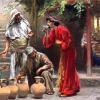
There were six stone water pots that the Jews used for ceremonial washing of hands before they ate. Each water pot held between 18 and 27 gallons of water.
Jesus told the servants to fill the water pots with water. They filled them to the brim. Jesus then told the servants to fill a cup from the water pot and take it to the ruler of the feast. They did as Jesus said.
When the ruler of the feast tasted the water that had become wine, not knowing where it came from, he called the bridegroom and said:
Usually the good wine is brought out first, and then after everyone has had a chance to drink freely, the poorer quality wine is brought out. But you have kept the good wine for last.
This is the beginning of the signs that Jesus did in Cana of Galilee. The signs and wonders he did manifested his glory. And Jesus’ disciples believed in him.
Contents - Prev - thestoryofjesus019 (jesuspub1) - Next
BIBLE - WEB,
KJV,
ASV(Quiz),
NIV,
개역한글KHRV(
120일1독,
1년1독,
권별,
성경통독
)
STUDY - 구절(WESLEY),
단락(MATTHEW),
테마별,
Dictionary - Chapter,
OT구약,
NT신약,
읽기(Wayne),
소요리,
대요리 문답,
신앙고백WCF
성경연대표
1.창조
2.족장
3.출애굽
4.광야
5.정복
6.사사
7.통일왕국
8.분열왕국
9.포로
10.포로귀환
11.중간
12.예수
13.초대교회
14.세계선교

JOHN 2: 1-11.
1 And the third day (From the calling of Philip (John 1: 43). The days enumerated in John's first two chapters constitute a week, and may perhaps be intended as a contrast to the last week of Christ's ministry (John 12: 1). It took two days to journey from the Jordan to Cana) there was a marriage (In Palestine the marriage ceremony usually began at twilight. The feast after the marriage was at the home of the bridegroom, and was sometimes prolonged for several days (Genesis 29: 27; Judges 14: 12); but in this case it seems likely that poverty limited the wedding feast to one day.) in Cana of Galilee (The site of Cana is disputed. From the eighth century a place called Kefr-Kenna (village of Cana), lying a little over three miles northeast of Nazareth, has been regarded as John's Cana of Galilee. But recently some ruins called Khurbet-Cana, twelve miles north of Nazareth, which doubtfully are said to have retained the name of Kana-el-Jilil (Cana of Galilee), have been preferred by some as the true site. In our judgment Kefr-Kenna has the stronger claim. It is situated on a westward slope of a hill, with a copious and unfailing spring adjoining it on the southwest); and the mother of Jesus was there (John never called our Lord's mother by her name. He assumes that she is known to his readers. This is one of the many points tending to show the supplemental character of John's Gospel. He avoids repeating what is found in the first three Gospels):
2 and Jesus also was bidden (being the Creator of woman, and the author of matrimony, it was fitting that the Son of God should grace a marriage feast with his presence) , and his disciples, to the marriage. (This is the earliest use of the term "disciples" in the ministry of Jesus. His disciples were Andrew, Peter, Philip, Nathanael, and probably John and James.)
3 And when the wine failed (Probably the arrival of Christ and his disciples helped to exhaust the supply. Shortage of provision when guests are invited is considered a sore humiliation the world over), the mother of Jesus saith unto him, They have no wine. (The interest which Mary took in the feast and the way in which she addressed the servants at John 2:5, suggests that she was a close friend of the bridegroom's family. Though she merely states the unfortunate condition to Jesus, her statement is a covert petition to him that would remedy it, as our Lord's answer shows. She practically requested him to work a miracle, nor is it strange that she should do this. Remembering the many early sayings about him which she had treasured in her heart (Luke 2: 19, 51), and doubtless being informed of what had occurred at his baptism, and of the proclamation which John the Baptist had made concerning him, and seeing a group of disciples gathered about him, it was very reasonable for her to expect him to do something which would reveal the high purposes for which he had been born.)
4 And Jesus saith unto her, Woman, what have I to do with thee? (Jesus did not call her "mother," but "woman," a term of courteous respect, but indicating no spirit of obedience. Says Augustine, "As much as to say thou art not the mother of that in me which worketh miracles." Moses recognized that parental duties were subordinate to divine (Deuteronomy 33: 9); and Jesus emphasized the principles (Matthew 10: 37). Jesus taught that relationship to him was spiritual, and not fleshly (Matthew 12: 46-50), and Paul coveted such relationship (2 Corinthians 5: 16-17). The expression, "What have I," etc., is used frequently in the Scriptures and invariably indicates a mild rebuke (Judges 11: 12; 2 Samuel 16: 10; 1 Kings 17: 18; 2 Kings 3: 13; Matthew 8: 29; Mark 1: 24; Luke 8: 28). It means, "leave me to act as I please," and Jesus uses it to assert that he is independent of all human relationships in the exercise of his Messiahship. It corrects two errors taught by the Catholic Church: 1. Catholicism says that our Lord's mother was immaculate, but if this were true she could not have incurred our Lord's rebuke. 2. Catholicism teaches that Mary's intercession is recognized by Christ. But this is the only instance on record of such intercession, and though it was addressed to Christ while in the flesh and was concerning a purely temporal matter, it was promptly rebuked.) mine hour is not yet come. (Our Lord's answer indicates that Mary's request had in it more than a desire for the gift of wine. What she principally wanted was to have Jesus manifest himself as Messiah. Now, Jesus gave many secondary, but only one supreme, manifestation of his glory or Messiahship. His miracles were secondary manifestations, but his Passion was the supreme manifestation (John 8: 28; 2: 18- 19; Matthew 12: 38-40). Jesus called this supreme sign his "hour" (John 12: 23-27; 17: 1; Matthew 26: 45; Luke 22: 53; see also John 7: 30; 8: 20). His mother sought for a supreme sign, but at that time only a secondary sign could be fittingly given. The triumph at Pentecost was not to be achieved at Cana.)
5 His mother saith unto the servants (though he had spoken words of rebuke, his mother was neither offended nor discouraged because of them), Whatsoever he saith unto you, do it. (She commands unlimited obedience. Though her words are not addressed to us, they will prove of untold profit to us if we obey them.)
6 Now there were six waterpots of stone set there after the Jews' manner of purifying (The details of the account suggest that John was an eye-witness. The Jews regarded themselves as ceremonially unclean if they did not wash their hands before eating--Matthew 15: 2; Mark 7: 3-4), containing two or three firkins apiece. (At Kefr-Kenna an old, one-story house near the lower edge of the village is regarded by the Greeks as the one in which this wedding feast was held. The room is a rude chapel, and at one side stand two old stone mortars, one holding about eight gallons and the other about ten, now used for immersing infants, but said by the attending priest to be two of the identical waterpots here mentioned. The simple-minded old man was not aware that the six waterpots held each two or three firkins apiece--between eighteen and twenty-seven gallons, a firkin being nine gallons--or double the quantity of his mortars. If he had known this, he might have chiseled out his mortars a little deeper!)
7 Jesus saith unto them, Fill the waterpots with water. (The jars had been partially emptied by the ablutions of the company.) And they filled them up to the brim. (This statement serves two purposes. 1. It emphasizes the great quantity. 2. It shows there was no room to add anything whatever to the contents of the jars. As to the quantity, it was between 106 and 162 gallons. As we do not know the number of guests nor the duration of the feast, we can not accurately measure the Lord's bounty. But as twelve basketfuls were left after feeding the five thousand, there was doubtless here a like sufficiency, and the surplus would serve as an acceptable gift to the married couple.)
8 And he saith unto them, Draw out now (the word "now" seems to indicate the turning-point when the water became wine), and bear unto the ruler of the feast. (According to the custom of that age, one of the guests was usually chosen to preside over such festivities, and he was called the ruler. Our modern toastmaster is probably a relic of this ancient custom.) And they bare it.
9 And when the ruler of the feast tasted the water now become wine, and knew not whence it was (but the servants that had drawn the water knew), the ruler of the feast called the bridegroom,
10 and saith unto him, Every man setteth on first (when the taste is sharpest, and most critical) the good wine (the adjective "good" refers rather to flavor than to strength); and when men have drunk freely (The ruler was no disciple of Jesus, and he speaks in the merry spirit of the world. He gives his own experience as to the habits of feasts, and his words give no indication that those present indulged to excess), then that which is worse: thou hast kept the good wine until now. (It is part of Christ's system to reserve the best until the last. Sin's first cup is always the sweetest, but with God that which follows is ever superior to that which has preceded it. As to the bearing of this miracle upon the question of temperance, the New Testament elsewhere clearly condemns the immoderate use of wine, and as these condemnations proceed from Christ we may rightly conceive of him, as in this instance, doing nothing contrary thereto. The liquors of this land in the strength of their intoxicating properties differ so widely from the light wines of Palestine that even the most moderate use of them seems immoderate in comparison. In creating wine Jesus did no more than as Creator and Renewer of the earth he had always done. From the beginning God has always so created or replenished the earth as to allow the possibility of excess.)
11 This beginning of his signs did Jesus in Cana of Galilee, and manifested his glory (This was the beginning or first of the miracles, and John's statement brands as false all the Catholic traditions which tell of miracles performed by Christ in his childhood. We should note also that it was a sign. The value of the miracle was in what it signified, not in what it wrought. It manifested the glory of Christ, part of which glory is his power to change the worse into the better, the simpler into the richer. It is the glory of Christ that he can transform sinners into his own likeness--1 John 3: 2; 1 Corinthians 15: 42-44; Philippians 3: 20-21); and his disciples believed on him. (In this chapter John as a disciple three times gives us a disciple's point of view as to Christ's miracles; here, and at John 2:22. They implanted faith in those whose hearts were right before God (John 5: 38). The miracles of Christ created widespread excitement. There had been none of a notorious nature since Daniel had been cast to the lions, and had read the writing on Belshazzar's wall some five hundred and eighty years before.)
|
|||||||||||||||||||||||||||||||||||||||||||||||||||||||||||||||||||||||||||||||||||||||||||||||||||||||||||||||||||||||||||||||||||||||||||||||||||||||||||||||||||||||||||||||||||||||||||||||||||||||||||||||||||||||||||||||||||||||||||||||||||||||||||||||||||||||||||||||||||||||||||||||||||||||||||||||||||||||||||||||||||||||||||||||||||||||||||||||||||||||||||||||||||||||||||||||||||||||||||||||||||||||||||||||||||||||||||||||||||||||||||||||||||||||||||||











|
1창세기[Genesis] 2출애굽기[Exodus] 3레위기[Leviticus] 4민수기[Numbers] 5신명기[Deuteronomy] 6여호수아[Joshua] 7사사기[Judges] 8룻기[Ruth] 9사무엘상[1 Samuel] 10사무엘하[2 Samuel] 11열왕기상[1 Kings] 12열왕기하[2 Kings] 13역대상[1 Chronicles] 14역대하[2 Chronicles] 15에스라[Ezra] 16느헤미아[Nehemiah] 17에스더[Esther] 18욥기[Job] 19시편[Psalms] 20잠언[Proverbs] 21전도서[Ecclesiastes] 22아가[Song of Solomon] 23이사야[Isaiah] 24예레미야[Jeremiah] 5예레미아애가[Lamentations] 26에스겔[Ezekiel] 27다니엘[Daniel] 28호세아[Hosea] 29요엘[Joel] 30아모스[Amos] 31오바댜[Obadiah] 32요나[Jonah] 33미가[Micah] 34나훔[Nahum] 35하박국[Habakkuk] 36스바냐[Zephaniah] 37학개[Haggai] 38스가랴[Zechariah] 39말라기[Malachi] 40마태복음[Matthew] 41마가복음[Mark] 42누가복음[Luke] 43요한복음[John] 44사도행전[Acts] 45로마서[Romans] 46고린도전서[1 Corinthians] 47고린도후서[2 Corinthians] 48갈라디아서[Galatians] 49에베소서[Ephesians] 50빌립보서[Philippians] 51골로새서[Colossians] 52데살로니가전서[1 Thessalonian] 53데살로니가후서[2 Thessalonian] 54디모데전서[1 Timothy] 55디모데후서[2 Timothy] 56디도서[Titus] 57빌레몬서[Philemon] 58히브리서[Hebrews] 59야고보서[James] 60베드로전서[1 Peter] 61베드로후서[2 Peter] 62요한일서[1 John] 63요한이서[2 John] 64요한삼서[3 John] 65유다서[Jude] 66요한계시록[Revelation] |
