

- 오늘의 예배

- 오늘의 한글성경
- 오늘의 WEB성경
- English Bible Story
- 01.창조시대 EBS
- 02.족장시대 EBS
- 03.출애굽기 EBS
- 04.광야시대 EBS
- 05.정복시대 EBS
- 06.사사시대 EBS
- 07.통일왕국 EBS
- 08.분열왕국 EBS
- 09.포로시대 EBS
- 10.포로귀환 EBS
- 11.중간시대 EBS
- 12.예수시대 EBS
- 13.초대교회 EBS
-----Readed_count
-----Update
Mobile Bible, Mobile B-Story, Today's iWorship, 요리문답, Quiz추가&수정, Dictionary추가&수정




BIBLE - WEB,
KJV,
ASV(Quiz),
NIV,
개역한글KHRV(
120일1독,
1년1독,
권별,
성경통독
)
STUDY - 구절(WESLEY),
단락(MATTHEW),
테마별,
Dictionary - Chapter,
OT구약,
NT신약,
읽기(Wayne),
소요리,
대요리 문답,
신앙고백WCF
성경연대표
1.창조
2.족장
3.출애굽
4.광야
5.정복
6.사사
7.통일왕국
8.분열왕국
9.포로
10.포로귀환
11.중간
12.예수
13.초대교회
14.세계선교

JOHN 2.13-25.
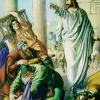
14 And he found in the temple (Our English word "temple" includes two Greek words; namely, 1. The naos, or sanctuary--the small structure which contained the holy and most holy places, and which answered to the tabernacle used in the wilderness. 2. The heiron, or entire court space which surrounded the naos, and which included some nineteen acres. The heiron was divided into four courts, and as one entered toward the naos from the east, he passed successively through them, as follows: 1, Court of the Gentiles; 2, of the women; 3, of Israel; 4, of the priests. It was in this outer or Gentiles' court that the markets described in this section were held) Those that sold oxen and sheep and doves, and the changers of money sitting (This market in the temple was for the convenience of the people, and the nearness of the passover increased its size. Oxen and doves were constantly needed for sacrificial purposes, and as each family which ate the passover required a lamb, they would be in the market in great abundance. Josephus tells us it required about two hundred thousand lambs for the passover feast, but his exaggerations will stand a liberal discount):
15 and he made a scourge of cords, and cast all (The rest of the verse shows that "all" does not refer to men, but to sheep and oxen. The scourge was used in driving them out) out of the temple, both the sheep and the oxen; and he poured out the changers' money, and overthrew their tables (The Jews were each required to pay, for the support of the temple service, one half-shekel annually (Exodus 30: 13; Matthew 17: 24). These money-changers sat at small tables, on which their coins were piled and counted);
16 and to them that sold the doves he said, Take these things hence (As the doves were in cages of wicker-work, they could not be driven out; hence Jesus called upon their owners to remove them. Though Jesus cleansed the house, he wrought no waste of property. The sheep and oxen were safe outside the temple, the scattered money could be gathered from the stone pavement, and the doves were not set free from their cages); make not my Father's house a house of merchandise. (Jesus bases his peculiar authority over the temple on his peculiar relationship to Him for whom the temple was built. As a Son, he purged the temple of his Father. In the beginning of his ministry he contested their right to thus appropriate his Father's house to their uses, but in the end of his ministry he spoke of the temple as "your house" (Matthew 23: 38), thereby indicating that the people had taken unto themselves that which truly belonged to God, even as the wicked husbandmen appropriated the vineyard (Luke 20: 14, 15). The rebuke of Jesus was addressed to the priests, for the market belonged to them, and the money-changers were their agents. Edersheim says that this traffic alone cleared the priests about three hundred thousand dollars a year. Though churches differ widely from the temple, they are still God's houses, and should not be profaned. Religion should not be mixed with traffic, for traffic tends toward sin. Phariseeism is its fruit--a wish to carry on profitable business, even with God. On this occasion Jesus objected to the use of the temple for trade without criticising the nature of the trade. When he purged the temple three years later, he branded the traders as robbers--Matthew 21: 13.)
17 His disciples remembered that it was written (Psalm 69: 9), Zeal for (loving concern for) thy house shall eat me up.
18 The Jews therefore answered and said unto him, What sign showest thou unto us, seeing that thou doest these things? (The Jews felt that only a divinely commissioned person could thus interfere with the ordering of God's house. They therefore called upon Jesus to give them a sign as an evidence that he possessed such divine commission. The manner in which he had cleansed the house of its trafficers was of itself a sign, if they had only had eyes to see it. Jesus could not have thus cleansed the temple unaided had he been a mere man. The power which he showed in the temple was much like that which he manifested in Gethsemane--John 18: 6.)
19 Jesus answered and said unto them, Destroy this temple, and in three days I will raise it up. (John here records this saying, and Matthew (Matthew 26: 61) and Mark (Mark 14: 58) tells us how at the trial it was twisted into a charge against Christ; thus the Evangelists supplement each other. For the temple in this sentence uses the word "naos," or sanctuary, the structure which was peculiarly the seat of God's presence. The sanctuary was a figure or symbol of the body of Christ, and the words of Jesus were a covert prediction that as they were desecrating the symbol so would they destroy his body, which it symbolized. They reverenced the Spirit of God neither as it dwelt in the sanctuary nor as it dwelt in the body of Christ. The body of Jesus was a temple (Colossians. 2: 9), and Christians and the church are also temples (1 Corinthians 3: 16, 17; 6: 19; 2 Corinthians 5: 1; 2 Peter 1: 13). God's temples can not be permanently destroyed. They are "raised up.")
20 The Jews therefore said, Forty and six years was this temple in building (The temple which then stood upon Mt. Moriah was the third structure which had occupied that site. The first temple, built by Solomon (B.C. 1012-1005), was destroyed by Nebuchadnezzar. The second temple, built by Zerubbabel and Jeshua (B.C. 520), had been torn down and rebuilt by Herod the Great, but in such a manner as not to interfere with the temple service. The sanctuary was completed in one year and a half, while the courts required eight years. Josephus says eighteen thousand workmen were employed in its erection. Additional outbuildings and other work had been carried on from that time, and the whole was not completed until A.D. 64), and wilt thou raise it up in three days? (To put before him the difficulty of what he apparently proposed to do, they merely mention one item--time. They say nothing of the army of workmen, nothing of a variety and cost of material, nothing of the skill required in the process of construction. How impossible seemed his offer! Yet by no means so impossible as that real offer which they misunderstood. A man might rear a temple in three days, but, apart from Christ Jesus, self-resurrection is unknown to history.)
21 But he spake of the temple of his body (John differs from the other three Evangelists, in that he frequently comments upon the facts which he records. Both history and commentary are inspired.)
22 When therefore he was raised from the dead, his disciples remembered that he spake this (It was three years before they understood this saying. Thus truth often lies dormant for years before it springs up in the heart and bears fruit--1 Corinthians 15: 58; Ecclesiastes 11: 1); and they believed the scripture (several passages foretell the resurrection--Psalm 16: 9, 10; 68: 18), and the word which Jesus had said. (They believed that Jesus had meant to predict that the Jews would kill him, and that he would rise again on the third day.)
23 Now when he was in Jerusalem at the passover, during the feast (the seven days' feast of unleavened bread--see Leviticus 23: 5, 6), many believed on his name, beholding his signs which he did. (We have no description of the miracles wrought at this time. See--John 4: 45; 20: 30.)
24 But Jesus did not trust himself unto them, for that he knew all men (The word here translated "trust" is the same as that translated "believe" in the preceding verse. They trusted him, but he did not trust them, for he knew them. He did not tell them anything of his plans and purposes, and the conversation with Nicodemus which follows is a sample of this reticence),
25 and because he needed not that any one should bear witness concerning man; for he himself knew what was in man. (John gives us many examples of this supernatural knowledge which Jesus possessed. See--John 1: 42, 47, 48; 3: 3; 4: 29; 6: 61, 64; 11: 4, 14; 13: 11; 21: 17. This chapter itself gives us a faithful picture of "what was in man." We find in it temple, profaners, money-makers, sign-seekers, opposers of reform, false and weak professors of faith, etc., but none to whom Jesus could trust himself.)
|
|||||||||||||||||||||||||||||||||||||||||||||||||||||||||||||||||||||||||||||||||||||||||||||||||||||||||||||||||||||||||||||||||||||||||||||||||||||||||||||||||||||||||||||||||||||||||||||||||||||||||||||||||||||||||||||||||||||||||||||||||||||||||||||||||||||||||||||||||||||||||||||||||||||||||||||||||||||||||||||||||||||||||||||||||||||||||||||||||||||||||||||||||||||||||||||||||||||||||||||||||||||||||||||||||||||||||||||||||||||||||||||||||||||||||||||











|
1창세기[Genesis] 2출애굽기[Exodus] 3레위기[Leviticus] 4민수기[Numbers] 5신명기[Deuteronomy] 6여호수아[Joshua] 7사사기[Judges] 8룻기[Ruth] 9사무엘상[1 Samuel] 10사무엘하[2 Samuel] 11열왕기상[1 Kings] 12열왕기하[2 Kings] 13역대상[1 Chronicles] 14역대하[2 Chronicles] 15에스라[Ezra] 16느헤미아[Nehemiah] 17에스더[Esther] 18욥기[Job] 19시편[Psalms] 20잠언[Proverbs] 21전도서[Ecclesiastes] 22아가[Song of Solomon] 23이사야[Isaiah] 24예레미야[Jeremiah] 5예레미아애가[Lamentations] 26에스겔[Ezekiel] 27다니엘[Daniel] 28호세아[Hosea] 29요엘[Joel] 30아모스[Amos] 31오바댜[Obadiah] 32요나[Jonah] 33미가[Micah] 34나훔[Nahum] 35하박국[Habakkuk] 36스바냐[Zephaniah] 37학개[Haggai] 38스가랴[Zechariah] 39말라기[Malachi] 40마태복음[Matthew] 41마가복음[Mark] 42누가복음[Luke] 43요한복음[John] 44사도행전[Acts] 45로마서[Romans] 46고린도전서[1 Corinthians] 47고린도후서[2 Corinthians] 48갈라디아서[Galatians] 49에베소서[Ephesians] 50빌립보서[Philippians] 51골로새서[Colossians] 52데살로니가전서[1 Thessalonian] 53데살로니가후서[2 Thessalonian] 54디모데전서[1 Timothy] 55디모데후서[2 Timothy] 56디도서[Titus] 57빌레몬서[Philemon] 58히브리서[Hebrews] 59야고보서[James] 60베드로전서[1 Peter] 61베드로후서[2 Peter] 62요한일서[1 John] 63요한이서[2 John] 64요한삼서[3 John] 65유다서[Jude] 66요한계시록[Revelation] |
