

- 오늘의 예배

- 오늘의 한글성경
- 오늘의 WEB성경
- English Bible Story
- 01.창조시대 EBS
- 02.족장시대 EBS
- 03.출애굽기 EBS
- 04.광야시대 EBS
- 05.정복시대 EBS
- 06.사사시대 EBS
- 07.통일왕국 EBS
- 08.분열왕국 EBS
- 09.포로시대 EBS
- 10.포로귀환 EBS
- 11.중간시대 EBS
- 12.예수시대 EBS
- 13.초대교회 EBS
-----Readed_count
-----Update
Mobile Bible, Mobile B-Story, Today's iWorship, 요리문답, Quiz추가&수정, Dictionary추가&수정





BIBLE - WEB,
KJV,
ASV(Quiz),
NIV,
개역한글KHRV(
120일1독,
1년1독,
권별,
성경통독
)
STUDY - 구절(WESLEY),
단락(MATTHEW),
테마별,
Dictionary - Chapter,
OT구약,
NT신약,
읽기(Wayne),
소요리,
대요리 문답,
신앙고백WCF
성경연대표
1.창조
2.족장
3.출애굽
4.광야
5.정복
6.사사
7.통일왕국
8.분열왕국
9.포로
10.포로귀환
11.중간
12.예수
13.초대교회
14.세계선교

MATTHEW 6: 19-34.
19 Lay not up for yourselves treasures upon the earth, where moth and rust consume, and where thieves break through and steal. (In our Lord's time banks, such as we have, were unknown, and in order to keep money its possessor frequently buried it, thus subjecting it to rust and corrosion. The havoc caused by moths is too familiar to need comment (Jasmes 5: 2). Costly and ornamental apparel was reckoned among a man's chief treasures in olden times. See Joshua 7: 21; 2 Kings 5: 5; Luke 16: 19. Oriental houses were frequently made of loose stone or sun-dried bricks, so that the thief found it easier to enter by digging through the wall than by opening the barred door. A too literal compliance with this negative precept would discourage thrift. The precept is not intended to discourage the possession of property in moderation, but it forbids us to hoard for selfish purposes, or to look upon our possessions as permanent and abiding. The lives of many men of our day seem to be employed to no other purpose than that of amassing an abundance of earthly treasure. But no true Christian can envy them, or follow their example):

20 but lay up for yourselves treasures in heaven, where neither moth nor rust doth consume, and where thieves do not break through nor steal (As the impossibility of hoarding earthly treasures is in the preceding verse urged as a reason against it, so in this verse the possibility of amassing perpetual possessions in heaven is set forth as the reason why we should do it. Thus the striking contrast between the two kinds of treasures is brought to our notice, so that it is the height of folly not to make a proper choice between them):
21 for where thy treasure is, there will thy heart be also. (Having contrasted the two treasures, Jesus here suggests the contrast between the two places where they are stored up. Since the heart follows the treasure, that it may dwell with the object of its love, we should place our treasures in heaven, even if the treasures there were no better than the treasures on earth; for it is better that our hearts should abide in the city of God than on this sinful earth.)
22 The lamp of the body is the eye: if therefore thine eye be single, thy whole body shall be full of light.
23 But if thine eye be evil, thy whole body shall be full of darkness. If therefore the light that is in thee be darkness, how great is the darkness! (In these two verses there is a brief allegory, the meaning of which is to be ascertained from the context. The subject under consideration is the propriety of laying up treasures, not on earth, but in heaven, and the effect which treasures have upon the heart. Now, the heart or affection is to the soul much the same as the eye is to the body. If we do not set our affections upon spiritual things, the time quickly comes when we can not see them (1 Corinthians 2: 14; John 3: 19-21). Jesus therefore represents our affections as if they were an eye. If the eye is single--i. e., if it sees nothing with a double or confused vision--then the man receives through it clear views of the outside world, and his inner man is, so to speak, full of light. But if his eye is diseased or blinded, then his inner man is likewise darkened. Applying the allegory to the spiritual man, if his heart is single in its love toward God and the things of God, then he has clear views as to the relative importance and value of things temporal and eternal, things earthly and things heavenly. But if the heart looks with a double interest upon both earthly and heavenly treasure, it makes the man double-minded (James 1: 6-8), and so spoils his life. God does not permit a double affection any more than he does a double service, and a man who seeks to continue in it will soon be visited with great darkness as to the things of God, and will become blind in heart and conscience--Romans 1: 21-25.)
24 No man can serve two masters: for either he will hate the one, and love the other; or else he will hold to the one, and despise the other. Ye cannot serve God and mammon. (Mammon was a common Chaldee word used in the East to express material riches. It is here personified as a kind of god of this world. Jesus here assumes that we are framed to serve (Genesis 2: 15); and hence that we must choose our master, for it is impossible to serve two masters whose interests are different and conflicting. They conflict here, for it is mammon's interest to be hoarded and loved, but it is God's interest that mammon be distributed to the needy and be lightly esteemed. God claims our supreme love and our undivided service.)
25 Therefore I say unto you, Be not anxious for your life, what ye shall eat, or what ye shall drink; nor yet for your body, what ye shall put on. Is not the life more than the food, and the body than the raiment? (The word "anxious" is derived from a word which indicates a state of doubt or double-mindedness. It therefore indicates that sense of suspense or worry which comes from a mind in doubt. Compare Luke 12: 29. Hence we may say that Jesus is here continuing the contrasts of the preceding verses, and that, having warned against a double vision and a double service, he now warns against a double mind as to the comparative value of the benefits to be derived from the service of God or the service of mammom. Mammon can only supply food, but God gives the life; mammon can only furnish clothing, but God gives the body. By single-mindedness we can find peace, for God is to be relied upon. By double-mindedness we fall to worrying, for mammon may fail to supply those things which we feel we need.)
26 Behold the birds of the heaven they sow not, neither do they reap, nor gather into barns; and your heavenly Father feedeth them. Are not ye of much more value then they? (Literally, do ye not greatly excel them. The birds do not serve mammon at all, yet God feeds them. Surely, then, man who excels the birds both in his intrinsic value and in his capacity for temporal and eternal service, can expect to receive from God his sufficient food.)
27 And which of you by being anxious can add one cubit unto the measure of his life? (Peace and trust characterize the service of God. The rewards of mammon, on the contrary, are won by anxiety. But the rewards of mammon can not lengthen life as can God. Therefore we should not hesitate to choose God's service.)
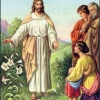
28 And why are ye anxious concerning raiment? Consider the lilies of the field, how they grow; they toil not, neither do they spin:
29 yet I say unto you, that even Solomon in all his glory was not arrayed like one of these. (The magnificence of Solomon and of his court is proverbial in the East unto this day. To the Jew he was the highest representative of earthly grandeur, yet he was surpassed by the common lily of the field. Which lily is here meant can not be determined. Calcott thinks it was the fragrant white lily which grows profusely all over Palestine. Smith favors the scarlet martagon; Tristam, the anemone coronaria; and Thomson, the Huleh lily, a species of iris. It is likely, however, that scholars are trying to draw distinctions where Jesus himself drew none. It is highly probable that in popular speech many of the common spring flowers were loosely classes together under the name lily.)
30 But if God doth so clothe the grass of the field, which to-day is, and to-morrow is cast into the oven, shall he not much more clothe you, O ye of little faith? ("This is the only term of reproach Jesus applied to his disciples" (Bengel). As to the grass and oven we may say that the forests of Palestine had been cleared off centuries earlier, and the people were accustomed to use the dried grass, mingled with wild flowers and weeds, for fuel. The oven was a large, round pot of earthenware, or other material, two or three feet high, and narrowing toward the top. This was first heated by fire within, after which the fire was raked out, and the dough put inside. Such is still the universal practice.)
31 Be not therefore anxious, saying, What shall we eat? or, What shall we drink? or, Wherewithal shall we be clothed? (God's care for the grass which lasts but for a day should teach us to expect that he will show more interest in providing for those who have been fashioned for eternity.)
32 For after all these things do the Gentiles seek. (Christians having a heavenly Father to supply their wants, should not live like the Gentiles, who have no consciousness of such a Father. Of what use is all our religious knowledge if we are still as careworn and distrustful as the benighted heathen?); for your heavenly Father knoweth that ye have need of all these things. (Here is the panacea for anxiety. Being God, the Supreme One knows; being a Father, he feels. Many repose with confidence upon the regularity and beneficence of his providential laws; but far sweeter is that assurance which arises from a sense of God's personal interest in our individual welfare--an interest manifested by the gift of his Son.)
33 But seek ye first his kingdom, and his righteousness; and all these things shall be added unto you. (The kingdom of heaven is the real object of our search. It must be sought first both in point of time and of interest, and it must be kept ever first in our thoughts after it is found. That Christian faith and obedience leads to worldly prosperity is proved by countless instances which are multiplied with each succeeding day. The security of Christ's kingdom leads to that cheerfulness which renews the strength, and to that undistracted industry which brings success.)
34 Be not therefore anxious for the morrow: for the morrow will be anxious for itself. Sufficient unto the day is the evil thereof. (Each day has trouble enough without adding to it by borrowing somewhat from the morrow. Serve God to-day with the strength you used to expend in carrying troubles which you borrowed from the future, and God will order the affairs of to-morrow.)

|
|||||||||||||||||||||||||||||||||||||||||||||||||||||||||||||||||||||||||||||||||||||||||||||||||||||||||||||||||||||||||||||||||||||||||||||||||||||||||||||||||||||||||||||||||||||||||||||||||||||||||||||||||||||||||||||||||||||||||||||||||||||||||||||||||||||||||||||||||||||||||||||||||||||||||||||||||||||||||||||||||||||||||||||||||||||||||||||||||||||||||||||||||||||||||||||||||||||||||||||||||||||||||||||||||||||||||||||||||||||||||||||||||||||||||||||














|
1창세기[Genesis] 2출애굽기[Exodus] 3레위기[Leviticus] 4민수기[Numbers] 5신명기[Deuteronomy] 6여호수아[Joshua] 7사사기[Judges] 8룻기[Ruth] 9사무엘상[1 Samuel] 10사무엘하[2 Samuel] 11열왕기상[1 Kings] 12열왕기하[2 Kings] 13역대상[1 Chronicles] 14역대하[2 Chronicles] 15에스라[Ezra] 16느헤미아[Nehemiah] 17에스더[Esther] 18욥기[Job] 19시편[Psalms] 20잠언[Proverbs] 21전도서[Ecclesiastes] 22아가[Song of Solomon] 23이사야[Isaiah] 24예레미야[Jeremiah] 5예레미아애가[Lamentations] 26에스겔[Ezekiel] 27다니엘[Daniel] 28호세아[Hosea] 29요엘[Joel] 30아모스[Amos] 31오바댜[Obadiah] 32요나[Jonah] 33미가[Micah] 34나훔[Nahum] 35하박국[Habakkuk] 36스바냐[Zephaniah] 37학개[Haggai] 38스가랴[Zechariah] 39말라기[Malachi] 40마태복음[Matthew] 41마가복음[Mark] 42누가복음[Luke] 43요한복음[John] 44사도행전[Acts] 45로마서[Romans] 46고린도전서[1 Corinthians] 47고린도후서[2 Corinthians] 48갈라디아서[Galatians] 49에베소서[Ephesians] 50빌립보서[Philippians] 51골로새서[Colossians] 52데살로니가전서[1 Thessalonian] 53데살로니가후서[2 Thessalonian] 54디모데전서[1 Timothy] 55디모데후서[2 Timothy] 56디도서[Titus] 57빌레몬서[Philemon] 58히브리서[Hebrews] 59야고보서[James] 60베드로전서[1 Peter] 61베드로후서[2 Peter] 62요한일서[1 John] 63요한이서[2 John] 64요한삼서[3 John] 65유다서[Jude] 66요한계시록[Revelation] |
