

- 오늘의 예배

- 오늘의 한글성경
- 오늘의 WEB성경
- English Bible Story
- 01.창조시대 EBS
- 02.족장시대 EBS
- 03.출애굽기 EBS
- 04.광야시대 EBS
- 05.정복시대 EBS
- 06.사사시대 EBS
- 07.통일왕국 EBS
- 08.분열왕국 EBS
- 09.포로시대 EBS
- 10.포로귀환 EBS
- 11.중간시대 EBS
- 12.예수시대 EBS
- 13.초대교회 EBS
-----Readed_count
-----Update
Mobile Bible, Mobile B-Story, Today's iWorship, 요리문답, Quiz추가&수정, Dictionary추가&수정





BIBLE - WEB,
KJV,
ASV(Quiz),
NIV,
개역한글KHRV(
120일1독,
1년1독,
권별,
성경통독
)
STUDY - 구절(WESLEY),
단락(MATTHEW),
테마별,
Dictionary - Chapter,
OT구약,
NT신약,
읽기(Wayne),
소요리,
대요리 문답,
신앙고백WCF
성경연대표
1.창조
2.족장
3.출애굽
4.광야
5.정복
6.사사
7.통일왕국
8.분열왕국
9.포로
10.포로귀환
11.중간
12.예수
13.초대교회
14.세계선교

MATTHEW 7: 1-6; LUKE 6: 37-42.
Matthew 7: 1 Judge not, that ye be not judged.
Luke 6: 37 And judge not, and ye shall not be judged (Here again Jesus lays down a general principle in the form of universal prohibition. The principle is, of course, to be limited by other Scriptural laws concerning judgment. It does not prohibit: 1. Judgment by civil courts, which is apostolically approved (2 Peter 2: 13-15; Hebrew 13: 17; Titus 3: 1). 2. Judgment of the church on those who walk disorderly; for this also was ordered by Christ and his apostles (Matthew 18: 16, 17; Titus 3: 10; 2 Thessalonians 3: 6, 14; 2 John 10; 1 Timothy 1: 20; 6: 5). 3. Private judgment as to wrong-doers. This is also ordered by Christ and his apostles (Matthew 7: 15, 16; Romans 16: 17; 1 John 4: 1; 1 Corinthians 5: 11). The commandment is leveled at rash, censorious and uncharitable judgments, and the fault-finding spirit or disposition which condemns upon surmise without examination of the charges, forgetful that we also shall stand in the judgment and shall need mercy (Romans 14: 10; James 2: 13). Our judgment of Christians must be charitable, (John 7: 24; 1 Corinthians 13: 5, 6) in remembrance of the fact that they are God's servants (Romans 14: 4); and that he reserves to himself the ultimate right of judging both them and us--Romans 14: 4; 1 Corinthians 4: 3, 4; 2 Corinthians 5: 10):
Matthew 7: 2 For with what judgment ye judge, ye shall be judged: and with what measure ye mete, it shall be measured unto you. and condemn not, and ye shall not be condemned: release, and ye shall be released (Though God shall judge us with absolute justice, yet justice often requires that we receive even in the same measure in which we have given it, so in a sense the merciful receive mercy, and the censorious receive censure (James 2: 12, 13). But from men we receive judgment in the measure in which we give it. Applying the teaching here given locally, we find that Jesus, having condemned the Pharisees in their manner of praying, now turns to reprove them for their manner of judging. Their censorious judgments of Christ himself darken many pages of the gospel. But with a bitter spirit they condemned as sinners beyond the pale of mercy whole classes of their countrymen, such as publicans, Samaritans, and the like, besides their wholesale rejection of all heathen. These bitter judgments swiftly returned upon the heads of the judges and caused the victorious Roman to wipe out the Jewish leaders without mercy. It is a great moral principle of God's government that we reap as we sow. Censorious judgment and its harvest are merely one form of culture which comes under this general law):
Luke 6: 38 give, and it shall be given unto you; good measure, pressed down, shaken together, running over, shall they give into your bosom. For with what measure ye mete it shall be measured to you again. (This is not necessarily a promise of the return of our gift in kind. It rather means that we shall receive an equivalent in joy and in that blessedness which Jesus meant when he said, "It is more blessed to give than to receive." The figurative language is borrowed from the market where the salesman, grateful for past kindnesses, endeavors, by pressing, shaking, and piling up, to put more grain into the measure for us than it will contain. Pockets were unknown to the ancients, and what they wished to take with them was carried in the fold in the bosom of the coat, the girdle below holding it up. Ruth bore this a heavy burden in her mantle which, in the King James Version is mistakenly called the veil--Ruth 3: 15.)
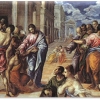
39 And he spake also a parable unto them, Can the blind guide the blind? shall they not both fall into a pit? (Whoso lacks the knowledge of divine truth can not so lead others that they shall find it. They shall both fall into the pitfalls of moral error and confusion.)
40 The disciple is not above his teacher: but every one when he is perfected shall be as his teacher. (Pupils do not surpass their teachers, or, if they do, they are self-taught, and hence do not owe to their teachers that wherein they rise superior to them. All that the scholar can hope from his teacher is that when he is perfectly instructed he shall be as his teacher. But if the teacher is a blind man floundering in a ditch, he affords but a dismal prospect for his pupils. The perfection of such teaching is certainly not desirable.)
41 And why beholdest thou the mote (chip or speck of wood dust) that is in thy brother's eye, but considerest not the beam (heavy house timber) that is in thine own eye?
Matthew 7: 4 Or how wilt (canst) thou say to thy brother, Brother, let me cast out the mote out of thine eye; that is in thine eye, when thou thyself beholdest not the beam that is in thine own eye? (and lo, the beam is in thine own eye?)
5 Thou hypocrite, cast out first the beam out of thine own eye; and then shalt thou see clearly to cast out the mote out of thy brother's eye. that is in thy brother's eye. (In Matthew and Luke Jesus gives slightly varying applications to this allegorical passage by setting it in different connections. In Luke, as we see, he places it after the words which describe the disastrous effect of being blind leaders of the blind. It therefore signifies in this connection that we ourselves should first see if we would teach others to see. In Matthew he places it after the words about censorious judgment, where it means that we must judge ourselves before we can be fit judges of others. The thought is practically the same, for there is little difference between correcting others as their teachers or as their self-appointed judges. Jesus graphically and grotesquely represents a man with a log, or rafter, in his eye trying to take a chip or splinter out of his neighbor's eye. Both parties have the same trouble or fault, but the one having the greater seeks to correct the one having the less. The application is that he who would successfully teach or admonish must first be instructed or admonished himself (Galatians 6: 1). In moral movements men can not be pushed; they must be led. Hence those who would teach must lead the way. Those who have reformed their own faults can "see clearly" how to help others. But so long as we continue in sin, we are blind leaders of the blind.)
6 Give not that which is holy unto the dogs, neither cast your pearls before the swine, lest haply they trample them under their feet, and turn and rend you. (The connection here is not obvious. This saying, however, appears to be a limitation of the law against judging. The Christian must not be censoriously judicial, but he should be discriminatingly judicious. He must know dogs and swine when he sees them, and must not treat them as priests and kings, the fit objects for the bestowal of holy food and goodly ornaments. Dogs and swine were unclean animals. The former were usually undomesticated and were often fierce. In the East they are still the self-appointed scavengers of the street. The latter were undomesticated among the Jews, and hence are spoken of as wild and liable to attack man. Meats connected with the sacrificial service of the altar were holy. Even unclean men were not permitted to eat of them, much less unclean brutes. What was left after the priests and clean persons had eaten was to be burned with fire (Leviticus 6: 24-30; 7: 15-21). To give holy things to dogs was to profane them. We are here forbidden, then, to use any religious office, work, or ordinance, in such a manner as to degrade or profane it. Saloons ought not to be opened with prayer, nor ought adulterous marriages to be performed by a man of God. To give pearls to swine is to press the claims of the gospel upon those who despise it until they persecute you for annoying them with it. When such men are known, they are to be avoided. Jesus acted on this principle in refusing to answer the Pharisees, and the apostles did the same in turning to the Gentiles when their Jewish hearers would begin to contradict and blaspheme. Compare Matthew 15: 2, 3; 21: 23-27; Acts 13: 46; 19: 9.)
|
|||||||||||||||||||||||||||||||||||||||||||||||||||||||||||||||||||||||||||||||||||||||||||||||||||||||||||||||||||||||||||||||||||||||||||||||||||||||||||||||||||||||||||||||||||||||||||||||||||||||||||||||||||||||||||||||||||||||||||||||||||||||||||||||||||||||||||||||||||||||||||||||||||||||||||||||||||||||||||||||||||||||||||||||||||||||||||||||||||||||||||||||||||||||||||||||||||||||||||||||||||||||||||||||||||||||||||||||||||||||||||||||||||||||||||||

















|
1창세기[Genesis] 2출애굽기[Exodus] 3레위기[Leviticus] 4민수기[Numbers] 5신명기[Deuteronomy] 6여호수아[Joshua] 7사사기[Judges] 8룻기[Ruth] 9사무엘상[1 Samuel] 10사무엘하[2 Samuel] 11열왕기상[1 Kings] 12열왕기하[2 Kings] 13역대상[1 Chronicles] 14역대하[2 Chronicles] 15에스라[Ezra] 16느헤미아[Nehemiah] 17에스더[Esther] 18욥기[Job] 19시편[Psalms] 20잠언[Proverbs] 21전도서[Ecclesiastes] 22아가[Song of Solomon] 23이사야[Isaiah] 24예레미야[Jeremiah] 5예레미아애가[Lamentations] 26에스겔[Ezekiel] 27다니엘[Daniel] 28호세아[Hosea] 29요엘[Joel] 30아모스[Amos] 31오바댜[Obadiah] 32요나[Jonah] 33미가[Micah] 34나훔[Nahum] 35하박국[Habakkuk] 36스바냐[Zephaniah] 37학개[Haggai] 38스가랴[Zechariah] 39말라기[Malachi] 40마태복음[Matthew] 41마가복음[Mark] 42누가복음[Luke] 43요한복음[John] 44사도행전[Acts] 45로마서[Romans] 46고린도전서[1 Corinthians] 47고린도후서[2 Corinthians] 48갈라디아서[Galatians] 49에베소서[Ephesians] 50빌립보서[Philippians] 51골로새서[Colossians] 52데살로니가전서[1 Thessalonian] 53데살로니가후서[2 Thessalonian] 54디모데전서[1 Timothy] 55디모데후서[2 Timothy] 56디도서[Titus] 57빌레몬서[Philemon] 58히브리서[Hebrews] 59야고보서[James] 60베드로전서[1 Peter] 61베드로후서[2 Peter] 62요한일서[1 John] 63요한이서[2 John] 64요한삼서[3 John] 65유다서[Jude] 66요한계시록[Revelation] |
